Saturday, May 14, 2022

In unplanned perfect Camino trail magic synchronicity, I have two new books coming out this spring, one week apart, from entirely different publishers, and both on the Camino de Santiago: 


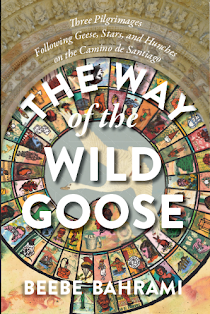
From Monkfish Book Publishing, The Way of the Wild Goose is a pilgrimage-turned-adventure story in pursuit of a pagan mystery on the Camino de Santiago across France and Spain: Through three pilgrimages across southern France and northern Spain that define a single journey on the Camino de Santiago, The Way of the Wild Goose recounts an inner and outer journey full of wild nature, ancient roads and history, quirky pilgrims, wise and humorous locals, and mysterious folklore. It’s a compelling tale of quest, initiation, and transformation following the Way of Saint James. The Way of the Wild Goose is also a detective story that reveals an old mystery: Why is the goose associated with the medieval Camino de Santiago, and how did it come to preserve a whole universe of pagan, preChristian lore in one innocent symbol? When I decided to find out, I unknowingly catapulted myself into a true wild goose chase, unearthing a magnetically alive and meaningful long walk on the ancient roads in France and Spain—and a journey of inner transformation. In The Way of the Wild Goose I return again to Sarlat, the same colorful and beloved home base as in Café Oc and Café Neandertal.

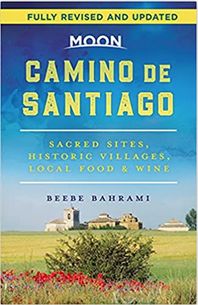
And from Hachette/Avalon/Moon is the fully revised and updated second edition of my guidebook, Moon Camino de Santiago: Sacred Sites, Historic Villages, Local Food & Wine:


 To a joyous spring, and always, ¡Buen Camino!

Friday, October 2, 2020

The moment I became a pilgrim


(A long overdue letter of thanks to the lady with water and sandwiches in Galicia...)


Dear kind Señora in remote coastal Galicia near Padrón, Spain,


Since I met you back in the early spring of 1995, I have met many trail angels, but you were my first. It was you who made me a pilgrim, possibly you who fueled this obsession, to walk long walks in sacred space and time. I have thanked you many times in my heart. I am pretty certain you have long forgotten what you did. Isn’t it remarkable how one seemingly little act can alter a whole life?


That spring was nine years after I first heard about the Camino de Santiago. In 1986, those three words lodged into me and I knew that one day, when I could, I would walk it. But despite the long years, you would think that I had a plan for it. Instead, when the moment arrived, I was utterly unprepared. In fact, I hadn’t planned to walk it just then.


I was coming up from southwestern Spain where I had just finished doctoral research for my dissertation. My husband, Miles, met me midway in Lisbon and we took the train north through Portugal and into Galicia, destined for Santiago de Compostela. I figured I had a few days to see the glorious city of legend and myth and then one day, a year or two later if providence allowed, I would return with more time to walk the whole trail from Saint-Jean-Pied-de-Port.


But just before reaching the train’s terminus in Santiago, we heard the train conductor announce, “last stop, Padrón.”


Padrón, right? Where Saint James first arrived by stone boat? Where this whole Santiago thing really begins?


Miles and I looked at each other and knew it had to start here. Just as the train was beginning to pull out of Padrón, we grabbed out packs and jumped. I heard an explosive, “¡Coños!” erupt from behind us, accompanied by the well-justified arm pumping of the conductor. But we landed well, knocked the dust off of the hems of our pants, and after visiting the town where Saint James’ stone boat purportedly moored nearly two thousand years, we began walking.


We had no map, no food, and no water. My thesis, all 500-pages of it, was strapped to the hood of my pack. We took the scenic route, a roundabout detour to walk along the coastal finger of land between Padrón and Noya. Only when we were out in the middle of nowhere did we realize what royal idiots we were. We entered a natural protected park, a rare place in Spain where there are no cafés.


“Don’t worry,” Miles said, “This here is a pilgrimage. Let’s trust the path to give us what we need when we need it.” With that sketchy plan, we pressed on.


Three hours later, seeing no one and no café, feeling an increasingly dry texture in my throat, I began to doubt Miles’ optimistic approach. But it was right then that you appeared, driving past us and serendipitously stopping you car on the roadside to check on something. I rushed over to you to ask you where we could find water and food.


“You’re in the middle of a protected natural park,” you’d answered, “so not very near here, except…” You smiled and opened your trunk, rooted through several bags, and then pulled out a large unopened bottle of mineral water and two sandwiches. You told us to take them, that you had just come from your grocery shopping, and, thinking of going for a hike later in the day, had on a whim picked up the water and bocadillos. You insisted and refused any payment. “This is pilgrimage,” you’d said and drove off.


This is pilgrimage.


Those three words reverberated in my mind and rewove my body and being. Christening us pilgrims, out there on that wild finger of land in the middle of nowhere, was a game changer for me. It was the very moment I turned into a lifelong pilgrim.


Your one act also seemed to have opened a magical door, one flowing with serendipity and synchronicity. The rest of the day, people showed up right as we needed guidance, sustenance, and support. By night, coastal villagers gave us a place to sleep and shared their dinner, just-caught fish and just-plucked vegetables from their gardens, along with homemade sparkling white wine.


Thanks to you, I became a pilgrim. Thanks to you and your many brother and sister Camino angels since, I have remained a pilgrim, and I continue to learn from you about grace, magic, generosity, and kindness with each step of the Way.


Mil gracias por todo.

Tuesday, October 30, 2018

A New Camino de Santiago Guidebook


The first time I set foot on the Camino de Santiago in northern Spain was in 1995, an unplanned adventure and soulful education in trail magic.

That life-changing journey led to my return to the trail many times since, so many that I have lost count.

I am excited to share that one major outcome of all those adventures on the trail is my forthcoming guidebook on the Camino de Santiago: Moon Camino de Santiago: Sacred Sites, Historic Villages, Local Food and Wine, due out April 2019.


And between now and then, here is an account, recently published in Perceptive Travel, about that first trek in 1995, which I call, The Way of the Octopus.


I hope the magic of trekking on sacred terrain offered by journeying on the Camino will capture you as much it has me. ¡Buen Camino!

Wednesday, February 8, 2017

Hiking the Dune du Pilat in the Arcachon Basin near Bordeaux, France


My friends Mel and Sue say that everyone has a dune story to tell when they come to this stunning southwestern French Atlantic outpost near Bordeaux.

When I hiked the Dune du Pilat, my dune story was the thrill of climbing to the ridge of the immense dune and having the constant bird's eye view of forest and ocean on either side. It was as if walking on the spine of a giant slumbering beast: I could also see the Arcachon Basin, an amazing estuary rich with diverse bird and sea life. I could just make out the waves at Cap Ferret, a narrow finger of land that almost closes the basin off from the ocean. And on my way up, I met a smart young Bavarian woman who was an agriculture student and spoke passionately about (re)creating a world where we grow good food locally and with sustainable practices. I hiked and learned and saw the potential of that world all around me.


When I descended from the spine after trekking the 6-kilometers long trail, I discovered a little open-air dune-side restaurant serving simply prepared, just-foraged mussels, perhaps the best I've ever eaten. The mussels came from just over the rise in the Arcachon Basin, and the chef was happy to share her recipe, noted below.

Arcachon and the Dune du Pilat are an easy day-trip from Bordeaux: Take the train from Bordeaux’s St-Jean station to the town of Arcachon where right in front of the train station is a bus going to the dune.  


Dune du Pilat Tarragon Mussels

1 ½ to 2 pounds fresh mussels, cleaned, rinsed, and discarding any that are open or broken.
1 small white onion, minced
1 tablespoon olive oil
¾ cup dry white wine
¼ cup fresh tarragon leaves stripped from the stem but not chopped.
Salt & pepper to taste

Sautee the onions in the olive oil in a large pot. Add the mussels, white wine, tarragon, and salt and pepper. Cover and bring the pot to a boil and then lower the heat to steam the mussels until they open. Once they open, take the mussels off the heat and discard any that did not open.

Enjoy the mussels with a glass of dry white wine (ideally, the same one you cooked with) and crusty bread or french fries.


Wednesday, August 12, 2015

The Camino de Vino Across Southern France and Northern Spain on the Way of Saint James


Both pilgrimage and wine are about the journey and on the Camino de Santiago the two are often in one glass


Nothing connects me more deeply to wine than walking eight hours a day through vineyard after vineyard across southern France and northern Spain on the Camino de Santiago, that thousand year old pilgrimage route to Saint James the Greater’s supposed tomb in Santiago de Compostela. Life unfolds at the pace of photosynthesis and footfall. At night the two fuse over a glass from the land and with the locals I met that day. (I've been walking this road, on different routes, since 1995 and it keeps calling me back. My most recent trek was this spring. There is always more to learn!)


In Gascony, heavy clusters of golden Petit Manseng hanging on a fence high upon a hill overhead dazzled me as the sun backlit them in late morning light like luminous angels descending from heaven. At night, I found a bottle of Jurançon from the vineyard and shared it with fellow pilgrims: It tasted like the day, a liquid journal, right down to the sweep of wind through sorghum and sunflowers and the distant moo from the caramel-cream spotted cow.

In Navarra, I took in a local glass at the old wine monastery of Irache’s fountain with two spigots, one for water and one for wine, a tradition carried on by Bodegas Irache to honor pilgrims and recall Jesus’ first miracle. Like Jesus’ wine, theirs was pretty good.


In Leon, I joined the harvest and stomped Tempranillo with acquaintances in an old bathtub in their garage. We barreled and stored the future wine then uncorked prior years’ vintages and feasted all night on backyard grilled paprika chicken, potatoes, and salads plucked from the garden.


In Galicia, at Santiago at last, two brother chefs at Café Iacobus celebrated my finish with a gift, grilled sea scallops and a glass of small-production Albariño, both procured from the same coastal spot.

 
How can one separate the Camino from wine when this intimately bound together?

The Camino’s making was directly connected to winemaking. With their medieval building campaigns to support the pilgrimage, celibate foodie monks also revived the interrupted ancient wine craft brought to southern France and northern Spain by Phoenicians, Greeks, and Romans millennia before. On the church stones they engraved copious wine scenes, from wine miracles (water to wine, wine to blood) to the vine representing Jesus who sustains it all.


When around AD 1139 the monk Aimery Picaud wrote Europe’s first travel guide, The Pilgrims’ Guide to St James of Compostela, he praised the wines of Bordeaux, Estella in Navarra, and Carrion de los Condes in Castile. In Galicia, so close to Santiago, he bemoaned wine’s scarcity but in the same pen-stroke praised the cider.


If Picaud and the other monks had wine as much as salvation on their minds, I feel fine following in their footsteps. The Camino will work this magic anyhow, weaving the walker into the sacredness of the land and people, with wine as its conduit.


Some Camino wines with heavenly little plates:

Southwestern France
Gascony
Jurançon sec and Abbaye de Belloc sheep’s milk cheese
Madiran and dry cured duck prosciutto with fresh figs

Basque Country
Irouléguy rosé with jambon de Bayonne and melon

Northern Spain
Rioja
Crianza and sautéed wild mushrooms with garlic and thyme

Bierzo
Mencía and spicy lamb meatballs in tomato sauce

Rias Baixas
Albariño and grilled sea scallops and chives

Tuesday, July 22, 2014

Najera’s Cave, Rioja, Spain

(among the most magical (and often most-overlooked) places on the Camino to Santiago de Compostela, Spain, begun on 6 June 2014)


Straddling the pretty Naverette River with red sandstone cliffs and green river banks, Nájera is a gregarious town hiding a holy cave. 


The monastery, Monasterio de Santa María la Real, is built right into the cliff. Upon entering you pass through the cloister with its delicate Gothic-arched latticework and then deeper in you reach the church. 


In the very back is the cave, discovered in AD 1044 when the king of Navarra, García III, followed his hunting falcon, who was pursuing a partridge. Behind the thicket hiding the cave he spied a mysterious light and discovered Our Lady of Nájera surrounded by white lilies and the two birds, now good friends rather than predator and prey. 


You can visit the red sandstone cave, most likely carved out of the soft stone around the 3rd century. It was then forgotten, overgrown by forest and hidden, until that mystical day in the 11th century.

More on Nájera's folklore. 

Friday, June 27, 2014

San Pedro de la Rua, Estella, Navarra

(among the most magical (and often most-overlooked) places on the Camino to Santiago de Compostela, Spain, begun on 6 June 2014


  Called “Estella la Bella” in the Middle Ages, Estella remains beautiful and is packed full with sacred sites but none that exceed the 12th century hilltop church of San Pedro de la Rua.  


The doorway is a multi-lobed Mudéjar style by Muslim craftsmen working in medieval Christian Spain. The archway holds several mystical keys often missing in other entranceways. One medallion over the arch points shows the hand of God holding up three fingers for the Trinity. Another depicts a lamb and the chi-rho that both represent Christ, but notice that the Alpha and Omega are in reverse, leading some to believe that the artisan was influenced by Arabic or Hebrew, both of which are written from right to left. 


Islamic creatures populate the arches, such as the two Persian-style winged birds on the left capital. Interwoven throughout the arches are Biblical tales, fanciful plants, and Celtic knots. 


 Inside is an open, rounded altar that holds Mary on the viewer's left, and left of her, an enigmatic pillar of three braided serpents. Mary is from the 13th century, but the three serpents are the 1893 restoration work of sculptor Cayetano Echauri who was a specialist of occult symbolism. He wanted to restore the medieval esoteric tradition of this region in his work. The three serpents represent good, evil, and wisdom and they are intertwined to represent the interplay of wisdom in discerning good from bad. 
  
Further back, San Pedro’s cloister reflects the mixed heritage from the front of the church, especially in the Basque pre-Christian solar disk tombstones and the Islamic Mudéjar-style plants and animals on the pillar capitals. 


To learn more about the deeper esoteric past and present in Estella and other mystical sites on the Camino, please see my book, The Spiritual Traveler Spain and my app (both on iTunes and Android), The Esoteric Camino France & Spain.

Thursday, June 26, 2014

Capilla de la Corticela, Santiago de Compostela, Spain

(among the most magical (and often most-overlooked) places on the Camino to Santiago de Compostela, Spain, begun on 6 June 2014)   


Inside the 12th century Romanesque cathedral of Santiago de Compostela are several splendid little universes.  

Among the most interesting is the Capilla de la Corticela, an overlooked little chapel just to the right of the northern entrance, the Puerta de la Azbachería. It was a 9th century church that was once separate from the cathedral but that eventually was absorbed into its expansion and reconfigured with a 12th century Romanesque entrance. 


Step through the threshold and you will likely discover that La Capilla de la Corticela has an amazing magic pulsating in it, as if the old magic of this Neolithic hilltop is for some reason strongest here. If you sit here and pray and meditate a while, you will also witness locals coming and going in their own magical engagement of the space, some leaving offerings and others writing wishes on slips of paper to deposit to the left of the shrine.

Eunate, Navarra, Spain

(among the most magical (and often most-overlooked) places on the Camino to Santiago de Compostela, Spain, begun on 6 June 2014)


Santa Maria de Eunate is a beautiful little remote round chapel surrounded by grazing sheep and rolling hills between Pamplona and Puente la Reina. 


No one knows who built this octagonal chapel dedicated to Mary. It may have the Templar Knights, who were inspired by the eight-sided Church of the Holy Sepulcher in Jerusalem. What makes this 12th century church all the more enigmatic is its 33-arched cloister surrounding the outside of the church like Saturn’s rings and that eunate is the Basque word for “one hundred doors.” 


From Basques to Christians and Muslims, there is a mixed ancestry at work here. 


Thirty-three is Jesus’s age when he was crucified. Jesus is a part of a holy trinity. Prayer beads in Islam number 33 and are circled three times to meditate on the 99 names of God. Eunate’s 33 arches can be walked around three times like a labyrinth or  walking rosary, arriving at 99. Enter the chapel door and you have “one hundred doors.” 


That this meditation is set in one of the most enchanted landscapes of northern Spain adds to its depth.

Friday, June 6, 2014

Ara Solis, Finisterre, Galicia


(among the most magical (and often most-overlooked) places on the Camino to Santiago de Compostela, Spain, begun on 6 June 2014)   

Finisterre, an outcropping of land jutting into the Atlantic Ocean along Galicia’s rugged fishing coast, is considered a final destination of the Camino after Santiago de Compostela. Here, the old Roman road across northern Spain also ends, marked by the Ara Solis, an altar to the dying sun. It was once located on the highest point near Finisterre’s present-day lighthouse. 


Finisterre also appears to have been the end of an initiatory road dating back before the Romans, to Celtic and perhaps Neolithic times, as indicated by the ancient remains of a nearby Neolithic stone circle on Monte San Guillermo and other Neolithic and Celtic remains sprinkled along Finisterre’s jagged coastline. 


Pre-Christian lore survives concerning fertility rites among women who were having trouble getting pregnant: They would visit a dolmen nearby, on Mount Fache, a tall, vertical dolmen that once stood there, hoping to improve their chances through proximity to its symbolic potency. Too explicit and disturbing for an 18th century bishop, he had the dolmen destroyed. While the dolmen is gone, the climb is exhilarating for the stunning view and feeling of being on top of the world.

The most magical (and often most-overlooked) places on the Camino to Santiago de Compostela, Spain


Thanks especially to Shirley MacLaine, Paolo Coelho, and Martin Sheen, the Way, the Camino across northern Spain, is as popular today as it was in the Middle Ages. 

But unlike medieval pilgrims who were taking their time, modern pilgrims tend to miss some of the most magical sites on the Camino, walking right past them in a rush to their next bed or meal. 

The Camino emerged in the ninth century after a hermit discovered the tomb of Saint James the Greater, one of Jesus’ twelve disciples, on a hilltop in northwestern Spain. That hilltop, which was also an ancient Neolithic burial ground, later became known as Santiago de Compostela, the Camino’s destination. 

The Camino was medieval Europe’s great adventure for the devout and the restless alike, and a repository of sacred and mystical lore sourced as much from its Christian birth as from the pagans, Jews, and Muslims who also lived and built along it. They collectively left a chain of magical sites strung across the wild beauty of northern Spain. 

In the next several blog entries, I share what I feel are the most magical but most often overlooked sites. I’ll begin by going backwards, the Other Way, as I like to call it, at the Atlantic coast in Galicia at Finisterre…


Friday, May 30, 2014

The Pilgrimage Roads to Santiago de Compostela

A YouTube video from an enchanting evening at Johnson County Community College in Overland Park, Kansas, talking about the Camino in France and Spain:  https://www.youtube.com/watch?v=BNXcSKu1U2E.

Tuesday, June 25, 2013

Romancing Neanderthals


I am about to head off to France for the summer to work on a book concerning Neanderthals and an international group of paleoarchaeologists who specialize in Neanderthals and early modern humans. For the Pilgrim's Way Cafe it is the ultimate pilgrimage to our roots. It also has me meditating upon our romance and popular imagination when it comes to these interesting human cousins.


The mass appeal of Jean Auel’s The Clan of the Cave Bear has shown that a lot of people are fascinated by this romantic tale of a young Upper Paleolithic woman, Ayla, and her adoption by a clan of Neanderthals. Auel’s book has also revealed that modern people, in some small or great way, romanticize Neanderthals and in a way that we don’t romanticize ourselves.

There is a constant pendulum swing of theories about the Neanderthals, who they were, and why they went extinct around 30,000 years ago, mostly, they say, thanks to us. These theories are engaging in part because the factual evidence, though growing, is still so scant that we want to fill in the spaces with a good human story. And it is a human story.

Not so long ago, based on the reading of the evidence, Neanderthals, already unquestionably established as skilled toolmakers, were also afforded art making, fire making, burial rites, and language. Recently, based on new evidence, some archaeologists find that Neanderthals used fire but it looks like they didn’t make it, that ritual burials may not have been the norm, and that what language and symbolic thought they had were restricted both physically and also culturally, meaning, maybe they had the burgeoning skills but did not trust that way of working in the world. This is in contrast to us moderns who took symbolic thought and ran with it. (But, this does suggest that Neanderthals had culture, which is a very human trait indeed.)

This assertion puts forth that our trust in the ability of symbolic thought and its cultivation over many generations led to new and more complex ways of living in our environment and gave us a survival edge, especially when food sources were scarcer. This adaptive difference became more apparent as we migrated into areas in Asia and Europe where Neanderthals lived; our ways may have competed with theirs in the same environment and maybe contributed to their extinction some 30,000 years ago.

But we did mingle. Recent DNA analyses of Neanderthal bone samples proved definitively that we interbred and that between 1-4 percent of DNA from modern humans from Asia and Europe is shared with Neanderthals. Which comes back to Auel’s evocative and poignant portrait of Ayla’s life among the Neanderthals, who even if more limited linguistically and symbolically, were no less feeling and sensitive.

Most recently, a new theory is circulating. Based on analyses of Neanderthal eye sockets and crania, it suggests that Neanderthals relied more on sight than we do; it suggests that while Neanderthals were dedicating a good chunk of their brain-power to visual skills, it came at the cost of developing other parts of the brain, such as the frontal lobe.

It is an intriguing idea. But is it too simple? We know that Neanderthal brains were larger than ours and even when we factor that larger portions were dedicated to sight and to managing a larger body build and musculature, we can’t deny that they looked a lot like us and that any theory about their brain would seem closer to the mark if it afforded a more complex analysis of cerebral functioning—even if different—that we grant ourselves when analyzing our own brains.

But I think here is the root of why so many of us romanticize Neanderthals: They are so very like us and many of us carry a bit of them within, and yet, they made different choices and were so different, too. As we look around our complicated world, complicated because of our exceedingly capable ability to manipulate our environment and communicate it to each other both face-to-face and to future generations, I think many of us actually long for a simpler life when we gathered around a fire as meat roasted and someone shared a story, whether through complex vocabulary or grunts and gestures. I think this especially as I look around and see so many people bending their visual and cognitive skills to little handheld devices while missing a stop sign or sidewalk curb.

Neanderthals, who lived from around 350,000 to 30,000 years ago, had a good long run of some 320,000 years. Anatomically modern humans have been around only for around 160,000 years. It is eminently clear that our choices made with our run-with-it-symbolically-oriented brains may very well determine if we will manage to live as long as Neanderthals did, an eye opening thought just in time to see the curb.


Thursday, December 20, 2012

A Peaceable Kingdom, On Pilgrimage in Rioja, Spain


I recall one day of walking the Way of Saint James, the Camino. When I got to Nájera, just west of Logroño in the Rioja wine region of northern Spain, it was an overcast day and I was hungry. But first, before it closed at midday, I wanted to visit the place of legend and myth that put Nájera on the map, and probably made it one of the important stops on the pilgrimage, the cave where Mary and Jesus appeared with two birds in AD 1044.

I walked toward the  red sandstone cliff that guards one side of this riverside town, where I knew I would find the Monasterio de Santa María la Real embedded into the natural stone wall. I reviewed the details of the legend in my head as I walked, wanting to retrace events as they are described.

It goes like this. One day in AD 1044, the Navarrese King García III was out riding and hunting with his falcon. The falcon suddenly flew after a partridge and both birds disappeared into a thick growth of trees.

The king dismounted and went into the trees to see what had happened to them. He found himself standing in front of a hidden cave. More unusual, an ethereal light poured out. He entered the cave and followed the light. At its source, he saw the falcon and the partridge sitting peacefully on either side of Mary, with the baby Jesus seated on her lap. In front of the celestial pair were lilies and a bell. 


King García never forgot this stunning vision and in AD 1056 he founded the monastery of Santa María la Real around and incorporating the cave. Today when you visit, you can visit the cave by passing through the church to the back wall that is still the natural cave.

The original cave was most likely carved out of the soft stone around the 3rd century, both for living as well as for defense. It was then forgotten, overgrown by forest and hidden, until that fateful day with the clever falcon in the 11th century.

Having fed the mystical hunger, it was time to feed my growling stomach before continuing the pilgrimage. I discovered that Nájera is a very warm and welcoming town. I went into a café that called to me, either for its beautiful riverside setting, or for the welcoming patron and clientele, or, just maybe, for the array of tapas splayed on the long wooden counter.

There I discovered another miracle, of the culinary kind: a little open-faced sandwich where the bread had been brushed and toasted with olive oil and then layered with roasted red pepper, thin slices of cured ham, jamón Serrano, and topped with a little fried quail’s egg.  Doubtless this exquisite tapa was paying homage to its cousin the peace-making partridge in the holy cave. 


Content and sated, I continued on, but doing as I do, walking in my own way. First, there was a detour to San Millán de la Cogolla, just south, and one back to Logroño (by bus) to visit yet another pilgrim’s detour at the Cistercian convent of Santa María de Cañas, just north. I also contemplated how many fine holy sites and pilgrim detours there were here in Spain’s most famous wine region. I think the two have something to do with each other.

If the deeper stories and legends of the Camino interest you, please check out my new app—both on iTunes and Android—The Esoteric Camino France & Spain.

Wishing you un buen Camino, un bon Chemin, and a good Road.